Error
  • JUser::_load: Unable to load user with id: 64
Blog

Bed Bugs - Do They Carry MRSA?

altAs many of you may have seen recently in the news, a study published in Emerging Infectious Diseases, a publication of the U.S. Centers for Disease Control and Prevention (CDC), reports that Canadian scientists detected drug-resistant staph bacteria in bed bugs from three hospital patients. The peer-reviewed study suggested bed bugs may be involved in transmitting disease.

It is critical to note that there is no evidence at this point that bed bugs have ever transmitted disease to humans, even though they have lived with humans for thousands of years. Scientists are simply hypothesizing based upon finding the pathogens in or on the bed bugs that they could transmit those diseases to humans. It has been shown that bed bugs carry more than 30 different human pathogens, yet no disease transmission has been proven, including in this study.

The two bacteria identified were methicillin-resistant Staphylococcus aureus, commonly known as MRSA, and vancomycin-resistant Enterococcus faecium, or VRE. We realize this may be cause for concern because both MRSA and VRE have been shown to be resistant to several common types of antibiotics.

The very small and isolated study, conducted in an impoverished community in Vancouver, British Columbia, tested a very small sampling of bed bugs collected from a few patients who were hospitalized for unstated causes. Marc Romney, one of the study’s authors, noted "even though this is a small study, it suggests that bed bugs may be playing a role in the transmission of MRSA in inner city populations where bed bug infestations are a problem."


Ants

Hello Friends of Skyline!  I hope this blog finds you growing your market and your effectiveness in “Making Dreams Come True!”  Here at Skyline we never forget that we are a part of that process.  We strive to make our part proceed as smoothly as possible.  This week I will discuss the “March of the Ants.”

This is a great time of year to be an ant.  Food is plentiful during the spring and summer.  Colonies rapidly grow in size as the queen ants become full-fledged egg-laying machines.  This means more human encounters as they multiply in our yards and inevitably find their way inside our homes.

Ant colonies constantly send out “scouts” to search for food, moisture, and nesting sites.  These scouts return to the colony with the good news!  On the return trip they lay down a chemical trail for their nest-mates to follow back to the food or moisture.  Soon this trail can become an “ant super highway” with hundreds or thousands of ants traveling on it.

This is the time of year when mature ant colonies send out fully reproductive, winged male and female swarmers with only one goal in mind – reproduction!  Some species of ants don’t even need swarmers.  These colonies generate multiple queens who can split off and start an entirely new colony.  This process is called “colony budding.”  One of our most commonly encountered species (argentine) utilizes this tactic as a defense mechanism when treated improperly.

You should always diligently eliminate food and moisture that might attract ants.  But to really prevent ant infestations you should be protected by one of our 2 Pest Protection Programs.  We are the Ant Specialists!  Our state certified and expertly trained technicians can control or prevent any ant problem. 

Call Skyline today if you, or someone you know, are having problems with this or any household pest.  As always – we are happy to help you with your Termite Letter or Certified Home Inspection needs.  Call today to experience “The New Horizon of Service!”

Those Were the Days - Rodent (Rat/Mouse) Bait - New EPA Regulations

altThe EPA has released a new set of rules governing the manufacture, sale, and use of rodenticides (commonly called rat or mouse poison or bait).  These new EPA regulations effect several different users of these products from professional pest control operators to retail consumers / homeowners.  The EPA’s main focus is to decrease children’s accidental exposure to rodenticides and to reduce the accidental exposure of pets and wildlife to rodenticides.  Dan Givens represents Univar – one of the leading Pesticide Distributors in the nation.  He provided me with the following information:


As you may be aware, important changes are occurring with rodenticides. The U.S. Environmental Protection Agency (EPA) has issued a Risk Mitigation Decision (RMD), effective for manufacturers June 4, 2011. Manufacturers are not permitted to ship any non-RMD products after this date. Products in distribution or already purchased by PMPs may be shipped and used as labelled with no deadline.

The RMD varies by user — professional, agricultural, and homeowner.


Professional users (Pest Management Professionals PMP's)continue to have all the same product forms and actives. However,
Second generation anticoagulants must be sold in 16 lb or larger sizes
First generation and non-anticoagulants must be sold in 4 lb or larger sizes
ALL outdoor above ground applications require bait stations, and if exposed to children or non-targets, stations must be tamper-resistant
Outdoor placements must be within 50’ of structures (This is a biggie - we can no longer treat fence lines or dumpsters which are farther than 50 feet away from the structure)


Agricultural Users (Commercial Farmers)continue to have all the same product forms and actives. However,
Second generation anticoagulants must be sold in 8 lb or larger sizes
First generation and non-anticoagulants must be sold in 4 lb or larger sizes
Second-generation actives limited to “in and around agricultural buildings only”
ALL outdoor above ground applications require bait stations, and if exposed to children or non-targets, stations must be tamper-resistant
Outdoor placements must be within 50’ of structures

Retail (Homeowner) Users

Pelleted baits of any kind no longer available for consumers
BAIT STATIONS WILL BE MANDATORY – Rodent baits only available for purchase by homeowners if sold in or with a bait station (block bait only allowed bait)
Only first generation anticoagulants and non-anticoagulants will be allowed
Maximum package size limited to bait amounts of 1 lb or less

If you have any additional questions, please go to www.riskmitigationinfo.com.


Can Bed Bugs Become a Fair Housing Issue?

altAn apartment owner was recently walking a prospective resident through his community when an awkward topic came up.  The prospect volunteered that he was looking for a new place to live because the place he was living in had bed bugs.


The owner was concerned about the prospect bringing bed bugs to his new home, but wondered about the fair housing implications. May an owner request or require that the prospect have all of his personal property treated before he moves into the "new" place? Does Fair Housing come into play in this situation? Fair Housing consultant Nadeen Green of For Rent Media Solutions says that bed bugs aren't a protected class, so Fair Housing is not involved here. "An awkward situation, yes, but I do not think that this would necessarily become a Fair Housing issue if handled correctly by the owner," Green says. "The key is to develop a policy for han­dling the bed bug issue and apply it to all prospective residents."


A good exercise for owners is to consider as many "what ifs" as possible. Examples might be: What if a prospect tells us their previous apartment had bed bugs? What if the newspaper had a recent article on bed bug infestation at ABC Apartments and this prospect is moving from that community to ours?


A policy could be along the lines of, "If we are told by prospects or have reasonably credible third-party information that prospects are coming from environments with a bed bug infestation, we will require the following, should the prospect qualify as a resident at our community: (fill in details)."   If that policy is then consistently applied, and if the leasing staff avoids applying a "lots of people from their country have bed bugs" mentality, then Fair Housing ramifications will not appear.


When conveying to residents their need to have their belong­ings sanitized, Mary Gwyn, Chief Innovator for Apartment Dynamics says, "It's not discriminatory for owners to tell resi­dents, 'Because there was a problem [at your previous home], I know you'll want to make sure you don't have one in your next home. So we'll need you to have everything treated and provide a statement to that effect. Here are the guidelines we give our residents on how to best handle your personal property so you can rest assured that the bed bugs won't move in with you."


Article Appeared in Units Magazine (March 2011)

-NAA 's -  Paul R. Bergeron III


If you are experiencing Bed Bug issues of any kind - directly or indirectly - Skyline Pest Solutions is the resource for you.  We have the most effective treatment protocol with Guaranteed Elimination.  Our program features step-by-step instructions for residents to help insure the elimination of the infestation. 


Carpenter Bees are Dive Bombing!

Hello Friends of Skyline!  I hope you are enjoying this beautiful Spring.  This week I will discuss those “Buzzing Bombers” of spring – the Carpenter Bee.

altThere are several different species of Carpenter Bees, but the most common one looks like a bumble bee.  This bee is unique because it bores into wood and, over time, does considerable damage.  They also bother homeowners and innocent passers-by with their diving “attacks.” 


Carpenter bees will bore into practically any wood including (but not limited to) overhangs, fascia boards, decks, fences, siding, sills, doors, etc.  Wood and cedar sided houses and barns are particularly vulnerable to Carpenter bee damage.  They bore a hole about ½” diameter.  This hole will go straight into the wood about 1-2 inches, turn 90 degrees, and then proceed to excavate a chamber. This chamber can be anywhere from 5-6 inches deep to 2 feet deep with branching chambers generally aligned with the grain of the wood.  They lay a single egg at the end of each chamber.  Food is placed into the chamber with the egg and the chamber is sealed.  I am including a picture of a carpenter bee and one of the nearly perfectly-round holes they create.                 


Females guard the nests aggressively.  Males are curious.  Both of these behaviors account for the “dive bomb attacks.”  The eggs hatch into larvae.  The larvae feeds on the food then metamorphoses into an adult Carpenter bee which then exits the hole.  This new generation of bees tends to make their homes in the same area as their parents.  A single nest one year will be 2 or 3 the next.  A few years of unchecked activity can lead to literally hundreds of holes, lots of bees, and considerable damage.


Skyline Pest Solutions has your answer if you or any of your acquaintances are dealing with these persistent pests.  Call us today and we will send a trained inspector to evaluate the situation and advise you on the corrective action we can take.  Our Carpenter Bee control program is very successful at reducing bee populations and the “attacks” and damage that accompany them.


As always, we are certainly available for your Termite Letter and Certified Home Inspection needs.  Call today to experience “The New Horizon of Service!”


Swarm! Termites? or Ants?

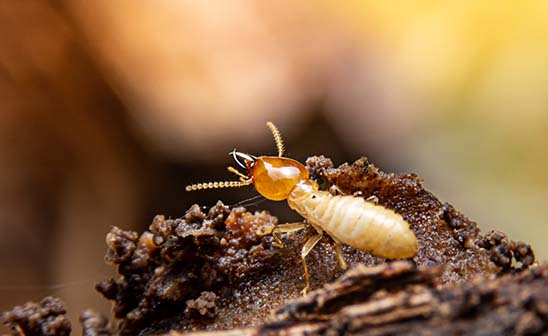
Starting now (early March) and lasting for the next few months, termites will start to take to the air with the goal of starting new colonies.  Thousands of these "swarmers" can emerge from a single mature termite colony.  A huge problem arises when the blind termites confuse our home for a stump!


altNot only are winged termites important because they can start new colonies, they are also a sign that one or more established termite colonies is in the area.  They are weak fliers and most stay within a several block area, but a breeze may blow them a mile or two away from where they emerged.  They could find their way into your home!  If you see many of them, they are probably coming from a colony that is already established in or near your home or business.


I am attaching an illustration of both a termite and an ant swarmer.  Ants often swarm at the same time as termites - and it is easy to mistake the two.  Note that unlike ants, the termite’s front and rear wings are nearly the same size, their waist is broad (nearly unnoticeable), and their antennae are never elbowed.   Proper identification is very important because the control techniques we use are very different for termites and ants – and termites will eat your house!


If you see either of these in or around your home - call Skyline!  Save some in a zip-lock or a jar for proper identification.  Whatever the pest, Skyline Pest Solutions will design the best control strategy to eliminate them.


Bed Bugs - Matress Cover or Encasement (by guest Contributer - Paul Bello)

Recently some e-mail conversations and announcements were forwarded to me. After reviewing these communications it appeared that some folks may have missed some key points on the role played by mattress encasements in a bed bug management program. With property managers informing their property owners that with the purchase and installation of mattress covers that their bed bug concerns were over, it was clear that some additional information about mattress encasements was warranted.


Mattress Covers vs. Mattress Encasements.  Mattress covers have been around a long time and, like most things, have evolved along the way. Mattress covers are not mattress encasements. Covers are intended to simply due as their name indicates, to cover the mattress. In doing so the low end and precursor units to today’s fancier models were simply intended to cover the mattress to prevent damage, stains and other such things from occurring to the mattress. For the most part, these covers simply cover the top. Currently available models may vary from a simple cover to plush padded pillow top type models that enhance the mattress. However, these covers are not bed bug proof encasements. They are merely covers.


Mattress encasements actually encase the mattress. Units are also available to encase box springs as well. Encasements fully encase, wrap or envelop the mattress or box spring. Once installed they zip shut to fully enclose the mattress or box spring within leaving no portion of the mattress or box spring exposed.


Bed Bug Tested & Bed Bug Proof. There are any number of models and brand name mattress encasements commercially available today. However, those units that have been engineered for and independently tested to be bed bug proof are the best choice for you especially if your intention is to enhance your bed bug management program. Note that in the free market economy buyer beware is a recurrent theme we should consider. 

As such, check out that the encasement you purchase is in fact independently tested at a credible research lab to be bed bug proof. If so, the manufacturer will have a supporting data publication available for your review on their website or within their sales information documents. Don’t be fooled by low cost or cheap imitations.


What does bed bug tested and bed bug proof mean? Sometimes, possibly more often than not, marketing claims and product performance data may be slightly different from each other. The phrase your mileage may vary comes to mind. This said, we need to understand what the phrases and terms being used actually mean. By bed bug tested and bed bug proof we mean that the encasement tested has proven to be bite proof, escape proof and entry proof by bed bugs. That is to say that a bed bug within the encasement is not able to bite a person through the material nor is it able to escape from the encasement through the zipper mechanism. Further, bed bugs are not able to enter these units from the exterior either through the fabric or through the zipper mechanism.


The role of encasements in bed bug management?  We need to clearly understand what the role of mattress encasements are in a bed bug management program. Just because you have installed mattress and box spring encasements does not mean that your property will not get bed bugs. It is still possible that bed bugs can be brought in to your property by a traveling guest or otherwise however, once encasements have been installed the mattress and box spring are protected from bed bug intrusion and fecal staining.


Take a quick look at a mattress and box spring. With pillow tops, decorative ticking and stitching mattresses offer bed bugs a multitude of hiding places where they may easily evade detection during a visual inspection. Perhaps even worse is the potential hiding places within a box spring. Once inside a box spring there are several locations where bed bugs may hide undetected by inspection while also evading subsequent bed bug control efforts. Suitably installed encasements prevent this.  Additionally, because encasements are essentially a smooth surface, bed bug activity is more easily detected during subsequent inspections should bed bugs be introduced.


All encasements are not created equal !  Again, it’s buyer beware! If you’re serious about bed bug management than you are not interested in poor quality and non-tested encasement units. Encasements come in varying qualities, features and benefits. The qualities of prime concern are durability and sleep comfort. After all, while it may be possible to successfully encase using 8 mill plastic sheeting, who wants to sleep on a sheet of plastic? Manufactures may offer a few models at different price points. In my experience, the higher end models offer greater comfortable and durability for use on a mattress. Of prime concern for a box spring encasement is durability and the ability to resist tears.


Which encasements are recommended? There are a number of manufacturers who offer quality mattress encasements. The units I recommend are manufactured by Mattress Safe located in Cumming, GA. Mattress Safe encasements have been tested bed bug proof by independent labs and have the advantage of being engineered such that the sides are stretchable while remaining bed bug proof. This is a huge advantage because the mattress height does not need to be measured to purchase the correct fitting encasement size as may be the case with competing brands. Go to www.mattresssafe.com for further information.


For which ever units you elect to purchase be sure that it has been tested bed bug proof and offers good comfort and durability. While the installation of encasements may not totally protect your location from an inadvertent bed bug introduction, they will help you to protect the valuable investment in your bedding and enhance your inspection and early detection success. Encasements are an important recommended portion of your ongoing bed bug management program.


The author, Paul Bello,  is a consulting entomologist and recognized bed bug management expert. 


Building a Better Bed Bug Trap

altBed Bugs are back with a vengeance!  In Georgia, here at Skyline, we saw a 200% increase in bed bug services from 2009 to 2010.  Current trends indicate that reports of bed bugs are growing at an even greater rate currently!  Bed Bugs are not limited to certain demographic or socio-economic situations.  Everyone is susceptible to infestation. 


Apartments, college dorms, and hotels are some of the current hot spots for bed bug activity.  Has anyone in your sphere been in any of these environments?  Bed bugs are readily transported from any of these environments into the home.  A residential infestation quickly follows.  We are treating more and more homes than ever.  Another scary thought is the fact that theaters have had infestations.  Some lesser-known but equally scary infestation locations include public libraries, hospital waiting rooms, hospital rooms, nursing homes, dental offices, cruise ships, and commercial airliners!


There is a fairly effective and inexpensive way to determine if there are bed bugs in an environment.  You can build a Bed Bug Trap with things you probably have around the house.  Here is what you can do if you suspect you might have bed bugs:


Materials:

1.       Plastic dog dish with hollow underside

2.       Masking tape

3.       ½ gallon insulated drink cooler with drain spout

4.       Unscented talcum powder

5.       2.5 pounds of dry ice (probably not around the house but easily obtained)


Directions:

1.       Cover the outside of the dog dish with masking tape so that the bed bugs can crawl up and in

2.       Turn the dog dish upside-down and place it within 10 feet of the suspected bed bug harborage

3.       Place a small amount of talcum powder within the upward-facing underside of the dog dish so that the bed bugs cannot crawl out

4.       Put the dry ice in the cooler, seal the lid, and slightly open the drain spout

5.       Put the cooler on top of the inverted dog dish

6.       Check your trap in 24 hours


The escaping carbon dioxide will attract any bed bugs present and your handy dandy trap will hold them there for your observation.  Bed bugs are close in size to a small tick.  If you identify them – contact Skyline immediately!  Bed bugs are controllable with the proper treatment methods.  It requires a very extensive, multi-method treatment protocol.  Skyline is your Bed Bug expert.


Rats & Mice - Common Myths

altAll sorts of wild myths about rats and mice circulate around through neighborhood gossip, late night talk shows, and on the internet.  Here are a few facts in response to some of the more common myths I hear:


Myth 1 – We have rats as big as cats around here!  In reality, the vast majority of adult rats usually weigh just under a pound.  Rats in rural areas, especially around farms, do sometimes grow larger.  The heaviest rat recorded thus far weighed 1.8 pounds.


Myth 2 – There is one rat per person in some major cities!  This is hard to verify as obtaining an accurate count of the rat population is impossible.  Some estimates say there could be several dozen rats per person in some areas!


Myth 3 – Rats and mice can’t see well.  While this may be true beyond 3 feet, they more than make up for it with their other senses.  They are sensitive to motion and vibrations up to 50 feet.  And their senses of hearing and smell are much better than ours!  They can locate objects to within a few inches just by sound.


altMyth 4 – Cats can control mouse and rat problems.  Cats may kill a rat occasionally, but it is usually a young or extremely old one.  Healthy rats are just too big for the average cat to handle.  In one study in India, there were more rats in homes with cats than homes without cats!  Cats vary greatly in their interest and ability to catch mice and rats.  If you want an animal for the job, the Rat Terrier dog is the way to go.


Here is the most important fact you should know – if you have a problem with rats or mice – call Skyline Pest Solutions.  We will send a state-certified inspector to expertly determine exactly what the extent of your rodent situation is.  Your inspector will then recommend a plan of action to eliminate the infestation!  Go to www.skylinepest.com for more information.


Close that door! (It is closed?!)

The cold, snowy, windy weather we have been experiencing should cause you take a good look at your home and how well it is protected from chilly drafts.  There are several factors that are essential for good household efficiency in the winter months – not the least of which is proper weather stripping around doors and windows.


Make sure that all weather stripping around all your windows and doors is present and in good shape.  This includes door sweeps under swinging doors.  Most of these seals are now constructed of vinyl.  This material should be relatively soft and pliable in order to ensure a good seal.  Making sure your seals are present and performing properly will help keep the cool drafts and household pests out.  Both are relentless in their pursuit of the warm interior of your home!


The best way you can know that your home is sealed properly is to schedule a comprehensive home inspection with Skyline Home Inspections.  Door and window seals are one of the areas that our inspectors focus on when they examine the current condition of your home.  Our report includes digital pictures of areas of concern to help you better understand the situation.  The report can be emailed, faxed, or our favorite – hand delivered to you at any location you specify.


Of course to eliminate those pesky pests - Skyline’s Pest Control Program is the way to go.  Skyline Pest Solutions will customize an Integrated Pest Management program targeting the pests that are giving you problems.  We will eliminate the current issue and protect your home from future invasions!


Who Loves Mosquitoes?

altWhen a mosquito lands on your arm, you know exactly why it’s there.  The puny pest is going to ‘bite’ you and swallow your blood.  If the mosquito’s eggs are to develop, it must have a blood meal.  Most would prefer animal blood, but they don’t hesitate to settle for yours.


The tube that pierced your flesh is no simple instrument.  Part of it does the cutting of your skin.  Part pours in mosquito saliva. Part draws out your blood.  It’s the saliva that causes most of the reactions and concern associated with mosquitoes.  Everyone is different - some have no reaction at all to mosquito saliva.  Others develop large bumps and allergic reactions usually accompanied with itching.  The saliva also carries a number of sicknesses that can be deadly to humans.  Yellow fever, malaria, and encephalitis are a few of the killer diseases that mosquitoes carry.

The world is in no danger of running out of mosquitoes anytime soon.  There are over 2000 different species.  One female can lay 400 eggs at a time and she’ll do it several times in one season (spring through late summer).  One glimmer of hope we have is that one third of all mosquitoes are eaten by birds, frogs, fish, and bats within one day of hatching.  Bad news – that leaves billions!  For more information -  http://www.skylinepest.com/fp-rokstories/mosquitoes


Skyline Pest Solutions offers the most effective Mosquito Reduction program available.  It begins with a total-property inspection to identify and eliminate potential breeding sites.  Sites that can’t be eliminated are treated with an environmentally-safe mosquito larvicide.  Then we treat the entire property to eliminate adult populations.  The final step is client education.  We make sure you know what you can do to insure that the mosquitoes stay away.  You don’t have to let mosquitoes have your yard!


Bed Bugs Are Back! - Facts 1


Bed Bugs infestations have returned with a vengeance!  Major metropolitan areas around the nation are experiencing an alarming growth of reports of bedbugs.  Because of their biology and behavior they are extremely difficult to control.  Here are some basic facts about bedbugs and why they are so hard to control.

·         They are nocturnal and exhibit a shy behavior during the daytime.  This usually makes them hard to detect until the infestation has grown to an alarming level.

·         They are thigmotactic – meaning they like to squeeze into tight spaces.  This means they will hide in every crack and crevice available within a structure.

·         Egg to adult development ranges from 5 weeks to eight months.  This means traditional pest control programs will not eliminate them.

·         Their lifespan ranges from six months to 1.5 years.  They can even go dormant and reappear months later.

·         Females lay eggs in batches from 10-50 and can produce up to 500 during their lifespan.  This means uncontrolled population can grow rapidly and exponentially

·         They cement their eggs in cracks, cervices, and wall voids.  This increases the survival rate of the eggs by protecting them from common treatment methods

·         They can go without feeding for up to 140 days.  This can give a false indication of control due to a lack of reported bites.

·         They travel very well within wall voids.  This makes room-to-room movement very likely and increases the difficulty of attaining elimination.

·         Pets, rodents, birds, and bats can act as hosts.  This increases the likelihood of infestation and could make the infestation increasingly mobile.


These are just a few of the facts that make the resurgence of bedbug infestations so alarming.  Skyline is a bedbug elimination expert.  If you experience or have contact with someone else who is experiencing bedbug infestation – contact Skyline Pest Solutions – “The New Horizon of Service!”


Are Your Tootsies Toasty? - Insulation Facts

As our team of home inspectors performs inspections on many homes around the Atlanta area, we begin to see many similarities in the issues discovered during each inspection.  One issue commonly identified is insufficient thermal insulation in the attic and/or crawlspace.  This is usually due to natural settling, trampling by homeowners storing items in the attic, or disturbance by pests and/or rodents.  The approaching cold of winter causes many homeowners and home buyers to become more aware of their home’s efficiency.  This awareness commonly causes them to look at their thermal insulation.  Another thing that makes homeowners examine whether their home is properly insulated is the arrival of that first gas/power bill!   Here is some information to consider when you are evaluating a home’s insulation system.


R-Value   Whenever you compare insulation products, it is critical that you base your comparison on equal R-values.  Insulation is rated in terms of thermal resistance, called R-value, which indicates the resistance to heat flow. The higher the R-value, the greater the insulating effectiveness. The R-value of thermal insulation depends on the type of material, its thickness, and its density. In calculating the R-value of a multi-layered installation, the R-values of the individual layers are added.  In the Atlanta area, R-30 is the recommended level of insulation for attics, R-15 for wall voids, and R-25 for floor voids.


Blankets, in the form of batts or rolls, are flexible products made from mineral fibers, including fiberglass or rock wool. They are available in widths suited to standard spacings of wall studs and attic or floor joists. They must be hand-cut and trimmed to fit wherever the joist spacing is non-standard (such as near windows, doors, or corners), or where there are obstructions in the walls (such as wires, electrical outlet boxes, or pipes). Batts can be installed by homeowners or professionals. They are available with or without vapor-retarder facings. Batts with a special flame-resistant facing are available in various widths for basement walls where the insulation will be left exposed.


Blown-in loose-fill insulation includes cellulose, fiberglass, or rock wool in the form of loose fibers or fiber pellets that are blown using pneumatic equipment, usually by professional installers. This form of insulation can be used in wall cavities. It is also appropriate for unfinished attic floors, for irregularly shaped areas, and for filling in around obstructions.  In the open wall cavities of a new house, cellulose and fiberglass fibers can also be sprayed after mixing the fibers with an adhesive or foam to make them resistant to settling.


Foam insulation can be applied by a professional using special equipment to meter, mix, and spray the foam into place. Polyisocyanurate and polyurethane foam insulation can be produced in two forms: open-cell and closed-cell. In general, open-celled foam allows water vapor to move through the material more easily than closed-cell foam. However, open-celled foams usually have a lower R-value for a given thickness compared to closed-cell foams. So, some of the closed-cell foams are able to provide a greater R-value where space is limited.


Reflective insulation systems are fabricated from aluminum foils with a variety of backings such as kraft paper, plastic film, polyethylene bubbles, or cardboard. The resistance to heat flow depends on the heat flow direction, and this type of insulation is most effective in reducing downward heat flow. Reflective systems are typically located between roof rafters, floor joists, or wall studs.


Radiant barriers are installed in buildings to reduce summer heat gain and winter heat loss. In new buildings, you can select foil-faced wood products for your roof sheathing (installed with the foil facing down into the attic) or other locations to provide the radiant barrier as an integral part of the structure. For existing buildings, the radiant barrier is typically fastened across the bottom of joists, as shown in this drawing. All radiant barriers must have a low emittance (0.1 or less) and high reflectance (0.9 or more).

The different forms of insulation can be used together. For example, you can add batt or roll insulation over loose-fill insulation, or vice-versa. Usually, material of higher density (weight per unit volume) should not be placed on top of lower density insulation that is easily compressed. Doing so will reduce the thickness of the material underneath and thereby lower its R-value.

Some types of insulation require professional installation, and others you can install yourself. You should consider the several forms of insulation available, their R-values, and the thickness needed. The type of insulation you use will be determined by the nature of the spaces in the house that you plan to insulate. For example, since you cannot conveniently "pour" insulation into an overhead space, blankets, spray-foam, board products, or reflective systems are used between the joists of an unfinished basement ceiling. The most economical way to fill closed cavities in finished walls is with blown-in insulation applied with pneumatic equipment or with sprayed-in-place foam insulation.

A home inspection will give you a good ‘snap-shot’ of your insulation’s condition.  There are many insulation companies around the Atlanta area who can provide an expert inspection and make recommendations to maximize your insulation’s effectiveness.  It is essential that your home is insulated properly to make sure you aren’t heating and cooling your crawlspace or attic.


Termite FAQ's - Now You Know!

Here are some of the most common questions I get asked about termites and termite protection:


Q:  Why do I need termite protection?

A:  The southeast provides the perfect geography, climate, and food and moisture sources for termite colonies to thrive.  Studies vary, but, they agree that there are approximately 7-14 termite colonies per acre.  The termites are there.  Our problem arises when we clear an acre of termite food (trees and bushes) then build our house out of termite food(wood) – right on top of the termites !


Q:  Do I need to have my house treated for termites every year?

A:  No.  Termite treatments last a minimum of 5 years.  It is very wise to maintain a termite warranty (sometimes incorrectly called a ‘bond’).  This warranty usually includes annual termite inspections.


Q:  I have a brick house.  Do I need to worry about termites?

A:  Yes.  Maybe even more.  This is one of the most common misconceptions in the exterminating industry.  During construction, the brick mason intentionally leaves a void behind the brick.  This void gives termites the protection they need – as well as plenty of moisture and all the food they can eat (your walls!)  Part of a state-code termite treatment is drilling behind the brick and applying product into the void to stop termites from entering it.


Q:  I have termites in my yard on a tree stump.  Will you spray that?

A:  It depends on how close the stump is to the house.  If the stump is within 5 feet of the foundation, or actually in the crawlspace or basement, we will treat it.


Q:  Which is better – the Liquid Barrier Treatment or the Advance Baiting System?

A:  It depends.  Each method of protection is equally effective and the warranties that come with each are equal.  There are several variables that need to be considered when answering this question.  We can make our most educated recommendation after a complete inspection is performed on the structure.


Crickets are Coming!

There is nothing nicer than hearing the crickets in the woods during a late evening stroll in early fall.  There is nothing worse than tearing a bedroom apart in the middle of the night looking for that lone cricket – driving you crazy (keeping you awake) with its mating call!  And they always seem to end up under the heaviest piece of furniture in the room!


Cricket populations are at their highest levels at the end of the summer.  With the weather changing and the nights getting cooler, crickets will begin to seek shelter indoors.  They come inside looking for moisture, food, and harborage.  Crickets can cause damage to homes, equipment, and textiles such as wool, silk, and fur.  A large cricket population is also an invitation to a number of other pests who consume them as food.


Here are some simple steps to help make sure this doesn’t happen to you again:  1)  Seal entry point around your home, such as door thresholds, windows, cracks, and plumbing/pipe penetrations.  2)  Reduce moisture sources around the exterior of your home.  The most common is the AC drip line dripping onto the foundation.  3)  Eliminate harborage areas around your home, such as tall grass/weeds, stacks of firewood, anything else a cricket could crawl under.


The most important step you can take – a properly implemented Pest Solutions program.  Skyline’s exterior perimeter application will stop them before they get in to torture you during the night!  Not to mention eliminating roaches, ants, spiders, and the like!


Home Inspection Snags - GFCI Outlets

Skyline Home Inspections serves the real estate community by offering Nationally-Certified Home Inspections.  Our inspectors are ASHI members and ICC Certified.  In this article I am going to provide some useful information on a common issue encountered with most of the home inspections we perform – GFCI outlets.

GFCI stands for ground fault circuit interrupter.  Code states that any receptacle/outlet within 3 feet of a water source or on the exterior of the structure (including attached garages) must be GFCI protected.   Multiple outlets may be connected through one GFCI protected circuit.  Newer homes tend to have reset switch outlets in each bathroom, the kitchen, and in the garage.  The purpose, of course, is to prevent electrocution caused by accidentally grounding a circuit.  Following is an explanation of how they work:


In North American homes the power provided is ground referenced.  What this means is that one of the conductors (the 'neutral') is actually connected to the ground.  This is allowed to occur in only one place per home - at the breaker panel.  Since electricity flows between the 'line' and the 'neutral' conductors, one can be electrocuted by touching the 'line' and anything else that is grounded.  This is where GFCI protected outlets provide benefit.  Ground Fault Interrupters operate by monitoring the current flowing in both the 'line' and the 'neutral' conductors.  Under 'safe' conditions, the currents in the 'line' and the 'neutral' should be equal.  An unsafe condition exists when there is an imbalance between the two currents.  This can occur when contact is made with the 'line' conductor and any grounded object.  The current is now flowing between the 'line' conductor being contacted, through ground, and back to the grounded 'neutral' conductor at the breaker panel.  The GFCI is designed to turn off the power when this happens.  

At Skyline Home Inspections, our inspectors check every accessible outlet and verify that GFCI protection is present and functional in each location that requires it.  This is just one of the details that are examined during each of our certified home inspections.  The Skyline difference appears in how the information is presented to the potential buyer.  Our inspectors understand that the goal is to get the deal closed.  Remember – “The Difference is in the Details!”

Home Inspection Goals

Skyline Home Inspections has a team of Nationally Certified Home Inspectors.  They are also members of ASHI (American Society of Home Inspectors) as well as ICC (International Code Council) Certified – meaning they can perform New Construction inspections. 


Our priority at Skyline Home Inspections, Inc. is to help you, as a Real Estate agent, close more deals.  Our professional inspectors offer an educational service to you and your clients.  They customize each report to reflect the current condition of the property and the estimated maintenance required to make it livable now and into the future.  They will prioritize needed repairs and maintenance and provide clear and concise advice on how to approach them. 


The information our inspectors provide should be acted on prior to taking ownership of the property.  Our inspectors are highly trained and experienced generalists.  They do have individual areas of expertise where they can make more detailed recommendations.  In most instances they will recommend that you and your clients consult with a specialist regarding the specific area or system where a concern has arisen.


The information gathered during the inspections phase is invaluable during the negotiation of a contract and prior to the new homeowner acquiring the property.  Our inspectors know how to communicate the concerns as well as the positives to the potential homeowner.  They enjoy giving people and agents piece-of-mind as a result of their inspections.  We want to show you that at Skyline - “The Difference is in the Details!”


Stucco - Hardcoat, Real, Synthetic - The Concerns

This blog will address an issue that affects all of us in the real estate and inspection industries – stucco veneer.  Stucco, even when constructed and applied properly, creates two concerns that must be continually monitored.


First, moisture has no way to evaporate if it gets behind stucco.  With brick veneer, masons insert “weep tubes” that allow the moisture that inevitably condensates behind any veneer (stucco included) to “weep” out.  Some brick masons just leave “weep holes” with no tube inserted.  Increased moisture levels behind stucco causes the trim and molding around windows to deteriorate sooner and encourages termites.  We all know that termites like moist wood.


Second, stucco prevents proper inspection and treatment of foundations when it is below grade (below soil level).  Termites love the void behind stucco veneer.  Even “real” or “hard-coat” stucco separates from the surface to which it was applied which creates this void.  This is why wire mesh is used – it supports the stucco when it dries and separates from the foundation.  Most builders do not intentionally apply stucco below grade.  It gets covered by the final backfill / landscaping grade.  


We have no way to treat or inspect behind stucco.  We can not apply liquid termiticide to the foundation or the soil immediately adjacent to it and we can not drill into the void like we can with brick.  The governing body for our industry has adopted a ‘Good Business Practice’ concerning stucco, RBI(Rigid Board Insulation), and EIFS (foam slab insulation).  Any reputable pest control company will require that stucco below grade be corrected by either altering the grade or cutting and removing the stucco which is below grade before issuing a clear Official Georgia Wood Infestation Inspection Report (a.k.a - Termite Letter).  They will also require any RBI or EIFS that is touching the soil to be remediated – that is removed to a height of 4-6 inches.  The purpose of this remediation is to create an ‘inspection gap’ so that an inspector can see signs of possible termite infestation on the foundation.


A while back in the Sunday AJC (business section), there was an article about a large Pest Control company that is currently going through a sizeable lawsuit because of its failure to follow these ‘Good Business Practices’.  Here at Skyline we feel it protects the seller, buyer, agent, broker, and of course us by following these practices. 


I know this is lengthy but I feel that it is good information.  Here at Skyline Pest Solutions & Home Inspections our inspectors are educated and trained to identify these concerns and recommend a corrective course of action that is best for the property.  

Summer Pests

Pests in Georgia enjoy our beautiful summers here as much as we do.  Most pests thrive in the warm summer months.  However, we usually experience an explosion of ants during these months.

Fire Ants start appearing, with their tell-tale mounds, all over our yards.  Encounters are unfortunate and very painful for the unsuspecting person disturbing a fire ant colony.  Argentine ants start trailing around the foundations of our homes and, inevitably, identify a moisture or food source inside.  This leads to trails of hundreds or thousands of tiny ants into bathrooms and kitchens.  Homeowner’s attempts to get rid of the problem themselves only make the problem worse.  Extremely dry or wet conditions will also force ants to seek shelter inside our houses.

Summer is also the time for mosquitoes and ticks to appear.  A few days after rain homeowners may notice squadrons of mosquitoes attempting a hostile takeover of their yard.  The rain causes most mosquito eggs deposited in the past to activate and develop into adult females who need a blood meal in order to reproduce.  They can become a menace and totally take away the enjoyment of your yard.  Ticks can also become a problem for children or pets.  Both of these pests can inflict bites that can transmit harmful diseases. 

Fight Back!  Take your yard back from Summer Pests!  Skyline’s Prevention Programs will let you enjoy the patio, pool, grill, and entire yard again.  Contact Skyline today!

{jcomments on} 

General Pests

Argentine Ants - Argentine ants a common pest in Georgia. They are about 3 mm long, dark colored. Their colonies have multiple queens. They like moist places and sweet food. They "farm" scales and aphids on plants, protecting them from predators, and consuming their sweet secretions. This damages the plants. You can often see their trails climbing trees, bushes, and buildings. They enter homes in search of food and water.

Killing worker ants has little effect, because the queens can produce many more workers. People commonly make argentine ants worse by spraying trails that come into the house with Raid or a similar OTC product.  This triggers a natural defense mechanism in Argentine Ants known as ‘colony budding’ that can actually make the problem worse.

Fire Ants - The red fire ant was accidentally introduced into the United States in 1929, when a cargo ship that had used soil as ballast arrived in Mobile, Alabama from South America. But South Americans don't have nearly the problem that the United States does. They only have 20% as many fire ants as we do, probably because North America lacks the natural enemies of their native area.

Fire Ants vary in size within one nest, from 1/16 to 1/5 inch long.  They are dark reddish-brown in color on the head and body, with a darker abdomen.   Mounds can be more than 15 inches high, 15 inches in diameter and up to 5 feet deep.   When disturbed they are aggressive, especially near the nest.  They inflict painful stings that raise a small welt.

Fire Ants are not picky eaters. They are omnivores and will eat almost any plant or animal material, including other insects, ground-nesting animals, mice, turtles, snakes, and other vertebrates, young trees, seedlings, plant bulbs, saplings, fruit and grass. When foraging for food, the oldest and most expendable 20% or so of the colony’s workers explore within 50 - 100 feet of the nest in a looping pattern.

American Cockroach - The American cockroach is a large cockroach, adults are approximately 1-1/2 inches long.  It is commonly called a ‘Palmetto Bug’ or a ‘Water Bug’.  The adult is a shiny reddish brown to dark brown.  Adult American cockroaches have wings and will occasionally fly. However, they are awkward fliers and prefer to run when disturbed.  American cockroaches generally live outdoors.  However, populations can also move indoors and live in human structures. American cockroaches usually live in moist, humid environments but can survive in dry areas if they have access to water.  American cockroaches usually infest basements, crawl spaces, bathrooms, and decorative landscaping.  American cockroaches feed on a wide variety of materials, including cosmetics, beer, potted plant shoots, wallpaper paste, soap, postage stamps, and fermenting fruit. They can foul human food, clothing, paper goods, and surfaces with their feces and body parts.

German Cockroaches – German Cockroaches are the most common pests in houses and restaurants.  Adult German cockroaches are light brown except for the shield behind the head marked with two dark stripes, which run lengthwise on the body.  They eat food of all kinds and may hitchhike into the house on egg cartons, soft drink cartons, sacks of potatoes or onions, used furniture, soft drink boxes, etc.

They can develop into large populations and live throughout the house, especially in the kitchen and bathroom. During the day, these roaches may be found hiding clustered behind baseboard molding, in cracks around cabinets, closets or pantries, and in and under stoves, refrigerators and dishwashers. When seen during the day in clusters, the population is large.  Some homeowners are allergic to roaches. The pests can contaminate food with certain bacterial diseases that result in food poisoning, dysentery, or diarrhea.

Centipedes & Millipedes - Millipede and centipede invasions have long been a problem for many homeowners.  They have been reported in every month of the calendar year. Thousands of migratory millipedes can create a mess. Once they die, expect a smell that can last for several weeks. Centipedes have been known to do the same, but usually in much smaller numbers. They are slow crawling, appear to have hundreds of legs and generally gray to light brown in color.

They love to live in decomposing thatch, leaves and mulch. They will get nutrition from these locations and may choose a root system of a nearby plant on which to feed. When they breed, the eggs hatch larva which will feed right where they emerge. This leads to large populations or nests which can number in the thousands. They will remain feeding as long as there is a food supply to support the nest. This could be for a year or two but at some point expect a migration. Excessive rain, drought, or lack of food will cause them to migrate. This phenomenon can occur at any time of the year and may result in several thousand moving in a direction that is in line with your home.

Earwigs - Earwigs are elongate, flattened insects, ranging from light red-brown to black and are easily recognized by their forcep-like appendages (pincers) on the end of their abdomen.  Earwigs may cause alarm to homeowners when discovered indoors. They have a frightful appearance, move rapidly around baseboards at the ground level, and may emit a foul-smelling, yellowish-brown liquid from their scent glands. These creatures, active at night while hiding during the daytime, normally live outdoors and do not establish themselves indoors. They are harmless to humans and animals, although if handled carelessly, the earwig can give a slight pinch with the forceps. Serious feeding damage may occur on flowers, vegetables, fruits and other plants, giving the leaves a ragged appearance with the numerous, small, irregular holes. Also, decomposing organic matter is consumed. They are considered temporary pests in spite of the fact that they sometimes occur in large populations.

Spiders – Spiders are one of the most common pests encountered in homes.  They are beneficial in the fact that they feed solely on other insects.  However, most homeowners are very afraid of them and not willing to share their home.  There are two species in Georgia that are harmful – black widow and brown recluse.  Black widows are relatively common and found in dark areas usually around the exterior of buildings – woodpiles, under crawl spaces, underneath gutter downspout shields, etc.  They are easily identified by the red hourglass shape that stands in stark contrast to their shiny black body located on the underside of their abdomen.  Brown Recluse spiders are not very common.  They are commonly found inside and outside – in areas that see little or no activity – like under furniture or behind appliances.  They are, as their name applies, very reclusive.  They will avoid contact with humans.  Brown Recluse spiders have a very distinct marking on the top of their body that looks exactly like a violin – giving them their common name of ‘Fiddleback Spider’.
 

  • Facebook Group: 52872928194
  • Flickr: SkylinePestPro
  • Linked In: skylinepest
  • Twitter: SkylinePestPro
  • YouTube: skylinepest

Testimonials

I love working with Skyline. When they come in the morning they are always so pleasant. They are also very hard working and have done a lot to keep our residents happy.

Commercial Account - Atlanta